Duingt: How a Small, Abandoned Train Station Became “Le Bon Wagon”

You’ve probably passed by here before… Maybe on a bike, maybe on foot, along the Voie Verte between Annecy and Doussard. You stopped for a coffee, or just to take a breather. You were at Le Bon Wagon in Duingt. And you didn’t know you were sitting in a train station that should never have existed...
It all began with an interminable wait. In 1856, there were plans to connect Annecy to Albertville. Not by car. By train. Back then, to travel along the lake, people took the steamboat between Duingt, Menthon, and Talloires. It was beautiful, but slow—and unreliable.
So they came up with the idea of a 40-km railroad line along the western shore. Except that it took forty-five years for the project to come to fruition. Forty-five years of paperwork, debates, and surveys.
In 1882, it was finally declared a public utility. In 1886, the project was entrusted to the PLM Company ( Paris–Lyon–MediterraneanRailway Company). And then came the first surprise: the official route didn’t include a station in Duingt. Trains stopped at Saint-Jorioz and at Doussard, but they passed right by Duingt without stopping. Imagine this: the train passes right under your windows, but it doesn’t stop at your town. Duingt wouldn’t stand for it. The town council is fighting for it, with the help of neighboring towns—Alex, Bluffy, Entrevernes, Menthon, and Talloires. Their argument is simple: Duingt is the crossroads. That’s the way to Annecy, to Faverges, and to the Thônes Valley. And that’s already where the only post office on the lake’s left bank is located. You can’t have a train pass through without stopping at the crossroads. The mayor, Count Henri de La Barge de Certeau, even had to intervene personally to ensure the station was built on the right side of the tunnel—where it still stands today. Without him, it would have been on the other side, toward La Maladière, and everything would have been different.
On June 3, 1901, after a 45-year wait, the station finally opened. It was a solid, almost unremarkable stone building. Downstairs were a cellar and a utility room. Upstairs was the stationmaster’s family apartment. There were four round trips a day. For the gatekeeper, life was dictated by the train: he had to report for duty eight times a day, with each passing train.
But the celebration lasted only 37 years. On May 5, 1938, passenger service came to a halt. The road had won out. Cars and buses were more flexible. The PLM was nationalized, and the SNCF took over. The line was gradually abandoned, eventually becoming a wasteland. Still, one memory remains that no one has forgotten. On September 22, 1941, in the midst of the war, a special train traveled along the line. On board was Marshal Pétain, traveling from Albertville to Annecy. The train spent the night in Sevrier, under heavy guard. It was one of the last great moments for this small line.
After that, silence. The station stood empty. It might have remained that way. But in 1951, its fate took a complete turn. And the reason was surprising: a 1949 law required large public companies to establish summer camps. So the SNCF transformed the Duingt station. It became the SNCF Jean Mossuz Water Sports Center, named after its first director. For more than thirty years, until 1985, thousands of children spent their summers there. They slept in large blue tents on the other side of the Route des Viviers. Later, an extension attached to the station served as a kitchen. Their days were filled with canoeing, kayaking, sailing, swimming, and hiking.
The gatekeeper’s house, meanwhile, was demolished in 1975. And then came the idea that would save it all. In 1976, two members of the Annecy Cycling Club, Jean Perdoux and René Boissier, looking at the old railroad track that had become a wasteland, said to themselves: “What if we turned it into a bike path?” At a time when everyone swore by the car, it seemed almost crazy. They were supported by Charles Bosson, a close associate of the Minister of Public Works. On October 23, 1976, the first section opened between Sevrier and Saint-Jorioz—six kilometers. In 1977, another six kilometers were added. Then more sections followed, year after year.
In 2000, it became official: it was designated a “Greenway,” open to all non-motorized vehicles and pedestrians. Today, guess how many people use it each year? 1.5 million. 1.5 million people pass through each year where the train once ran.
In 2003, SILA purchased the stations and the land. In March 2006, the town of Duingt bought back its station. But it wasn’t until 2021 that the site truly came back to life. The station and part of the former summer camp facilities were renovated.
This marked the birth of Le Bon Wagon.
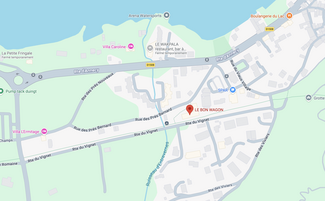
On one side, a café serving light meals. On the other, a bike repair and sales shop. Right at the tunnel exit, where the train used to run. People stop for a break, get their bikes repaired, and head back on their way.
The rest of the premises is managed by an organization called Les Bouchons 74. Its concept is simple, but the numbers are staggering: it collects metal, plastic, and cork bottle caps, which are resold to recyclers to fund assistance for people with disabilities. To fill a single semi-trailer, you need 12,000 kilos of plastic bottle caps. At five grams per cap, that’s 2.4 million caps. 2.4 million small acts to fill one truck. Recently, the organization has also started collecting aluminum cans.
What about the future?
Le Bon Wagon is expected to stay. Les Bouchons 74 might relocate to facilitate truck traffic; studies are currently underway. The Greenway continues to expand; the Annecy–Saint-Jorioz section is already well underway.
What about the train between Albertville and Annecy? That’s not happening anytime soon. It would take 200,000 residents on the west bank for it to be profitable.
But look how far we’ve come: in 1926, the train took between 2 hours and 10 minutes and 2 hours and 40 minutes to travel from Annecy to Albertville. Today, the Y51 bus takes between 1 hour and 20 minutes and 1 hour and 40 minutes, and it serves eleven towns, from Sevrier to Marthod. We’ve gained an hour in a hundred years. And most importantly, we’ve gained a place.
The next time you pass through Duingt, stop by Le Bon Wagon.
Based on the article by Jean-François Paille, “The Duingt Train Station on the Albertville–Annecy Line,” Riv’Ouest Magazine No. 22, Fall/Winter 2026.
Want to see Le Bon Wagon while cycling around the lake? Rent our bikes from Mobilboard and let the Voie Verte guide you, with a gourmet break by the lake along the way.
Check out our rental options:
- Bike rentals: https://www.mobilboard.com/fr/annecy/velo
- E-bike rentals: https://www.mobilboard.com/fr/annecy/velo-electrique